Follow us
Products · Products · Products · Products · Products · Products · Products · Products · Products · Products · Products · Products · Products · Products · Products · Products ·

Linear Bearing Solutions from China Factory

Home · Products · Linear Bearing

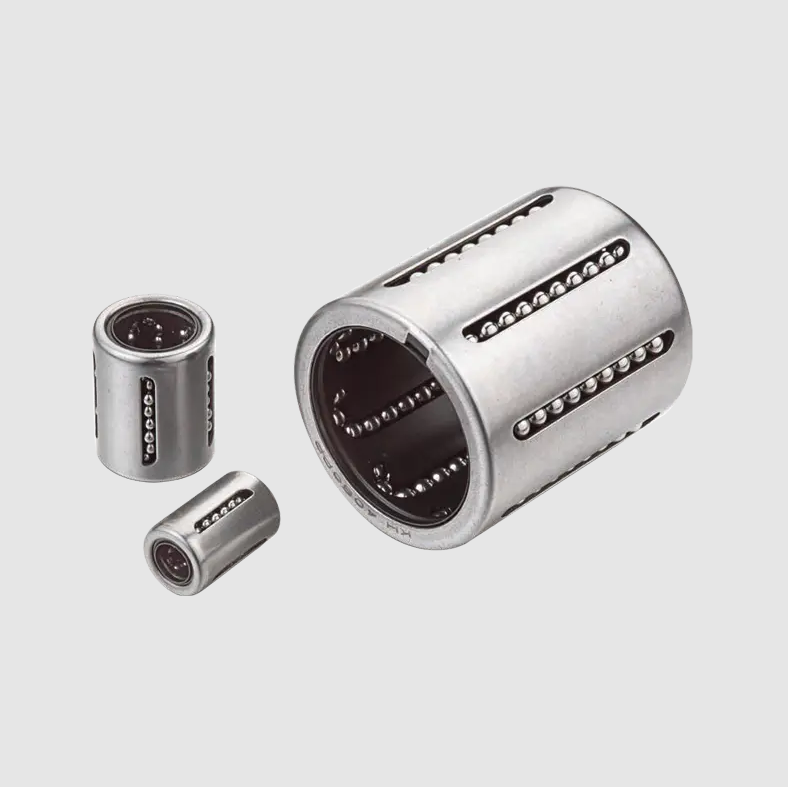
Linear Bearing

Linear bearings, as core components for achieving high-precision linear motion, are primarily classified based on their core structural form, installation method, functional characteristics, and dimensional specifications. This classification aims to meet the diverse needs of equipment ranging from general-purpose transmissions to high-precision devices for motion accuracy, load capacity, rigidity, ease of installation, and space adaptability.

The core classifications are as follows:

By Core Structure and Rolling Elements

Standard Linear Ball Bearings (Bushing Type): Such as LM-UU, LME-UU, SDM-UU, SDE-UU series and various variants. Using balls as rolling elements, they feature a standard cylindrical bushing structure, characterized by low friction, smooth movement, and high precision, making them the most common and economical choice.

Linear Roller Bearings: Such as LM-L-UU, LME-L-UU series. Using cylindrical rollers as rolling elements, they provide extremely high radial load capacity and rigidity, suitable for heavy-duty applications with stringent rigidity requirements and tolerance for small clearances.

Precision Shaft Bushings: Such as LMB-L-UU series. Typically high-precision, preloaded, or specially designed bushings, used to support and guide precision shafts, emphasizing guiding accuracy and low runout.

Classification by Installation and Shape Characteristics

Standard Cylindrical Type: This is the basic bushing form, requiring installation in a bearing housing or machined hole.

Flanged Type: A flange is integrated into the bushing for easy direct installation and fixing. Further subdivided according to flange shape:

Circular Flange Type (F): Such as SDMF-UU, LMF-UU.

Square/Rectangular Flange Type (K/H): Such as SDMK-UU, LMK-UU (square), LMH-UU (rectangular), providing greater installation stability and torque resistance.

Extended/Reinforced Flange Type (P/C): Such as LMFP-UU, LMHC-L-UU, further enhancing installation rigidity and load capacity.

Classification by Function and Adjustment Characteristics

Open/Adjustable Clearance Type (OP): Such as SDM-OP-UU, LM-OP-UU. The bearing outer sleeve has a slit, allowing for inner diameter adjustment via bolts to eliminate gaps with the mounting hole or achieve micro-preload, preventing bearing rotation within the hole.

Extended Type (L): Such as LME-L-UU, LMFP-L-UU. Increased bearing length improves guiding accuracy, rigidity, and service life.

Extended/Wide Type (C): Such as LMFC-L-UU, LMEFC-L-UU. Increased bearing width or flange size significantly enhances resistance to overturning moments and installation stability.

Linear bearing product systems determine core performance through rolling elements (balls/rollers), adapt to structural requirements through mounting methods (standard/flange), and achieve precision adjustment and performance enhancement through functional design (opening/extended/expanded). Users must comprehensively consider key factors such as load direction and magnitude, motion accuracy, installation space, rigidity requirements, and whether anti-rotation or preload is needed when selecting a model.

About
Lishui Wangong Precision Machinery Co., Ltd.
Lishui Wangong Precision Machinery Co., Ltd. was founded in 2008 and is located in Lishui City, Zhejiang Province. We take pride in our state-of-the-art R&D and production facility, covering an impressive 52,000 square meters. Our expertise lies in manufacturing precision transmission components, such as ball screw assemblies, linear guides, roller guides, linear shafts, and OEM & Custom Linear Bearing Solutions.

As a linear bearing supplier & factory direct wholesale, we seamlessly integrate research and development, production, sales, and service. We have successfully incorporated advanced equipment and cutting-edge technologies from renowned countries like Germany, Japan, and Taiwan. Our commitment to innovation has led to the acquisition of multiple product design patents, and we proudly adhere to ISO9001 certification standards.
Certificate Of Honor
  • Certification
  • Certification
  • Certification
  • Certification
  • Certification
  • Certification
  • Certification
News
Message Feedback

Linear Bearings for Industrial Motion Systems and OEM Equipment

Linear bearings are essential components in linear motion systems. They are designed to support smooth, low-friction movement along a straight path, usually working together with a linear shaft, guide shaft, optical shaft, support rail, or slide unit.

In many machines, linear bearings help moving parts travel accurately and consistently while reducing wear between contact surfaces.

A typical linear bearing may use a circulating ball structure, sliding bushing, bearing block, flange housing, or self-aligning design. Depending on the application, it can be used for positioning, guiding, reciprocating movement, equipment adjustment, or mechanical transmission support.

Common product types include linear ball bearing, linear motion bearing, linear bushing, linear bearing block, flange linear bearing, open linear bearing, closed linear bearing, self-aligning linear bearing, and stainless steel linear bearing.

What Is a Linear Bearing?

A linear bearing is a mechanical bearing used to create controlled straight-line motion. Unlike rotary bearings, which support circular movement, linear bearings allow components to move back and forth along a shaft or guide system.  

In most applications, the bearing is installed inside a housing, block, carriage, or machine frame. It slides along a hardened shaft or supported rail while carrying a specified load.

This structure helps reduce friction, improve motion stability, and support repeatable movement.

Linear bearings are widely used because they are compact, simple to install, and suitable for many machine designs.

They can be selected according to:

  • Shaft diameter
  • Load rating
  • Movement speed
  • Accuracy requirement
  • Housing style
  • Sealing structure
  • Working environment

Industrial Applications of Linear Bearings

Linear bearings are widely used in industrial equipment where smooth and guided linear movement is required.

Common application areas include:

  • Automation production lines
  • Packaging machinery
  • Electronic assembly equipment
  • Semiconductor equipment
  • Medical testing devices
  • CNC machines
  • 3D printers
  • Laser equipment
  • Robotic systems
  • Vision inspection machines
  • Dispensing equipment
  • Printing machinery
  • Textile machinery
  • Fixtures and jigs
  • Laboratory automation systems
  • Custom automation equipment
  • OEM machinery projects
  • Maintenance and replacement applications

For equipment designers and sourcing teams, the main selection factors usually include shaft size, load capacity, movement speed, required accuracy, installation space, noise level, lubrication method, and total cost.

Linear Bearing vs. Linear Guide

Item Linear Bearing Linear Guide
Matching Part Round shaft or support rail Profile rail
Structure Simple and flexible More rigid and compact
Load Capacity Suitable for light to medium loads Suitable for higher loads
Accuracy Good for general motion Better for precision motion
Installation Easy to arrange in many layouts Requires more accurate mounting surface
Cost Easier to control Usually higher

The right choice depends on the machine structure, load direction, accuracy requirement, mounting space, and operating conditions.

How Do I Choose the Correct Linear Bearing Size?

Shaft Diameter

The bearing inner diameter must match the shaft size such as 8 mm, 10 mm, 12 mm, 16 mm, 20 mm, or larger specifications.

Load Requirement

The bearing should support the actual working load with sufficient safety margin.

Movement Speed

High-speed applications may require better lubrication, smoother shaft surfaces, and tighter quality control.

Installation Space

Outer diameter, flange style, and bearing length should fit the machine structure properly.

Operating Environment

Dust, humidity, corrosion, and temperature should be considered during material and sealing selection.

Accuracy Requirement

Precision equipment may require tighter clearance and better shaft straightness.

Steel vs. Stainless Steel Linear Bearings

Feature Steel Linear Bearing Stainless Steel Linear Bearing
Hardness Generally high Depends on stainless grade
Wear Resistance Good for general use Good with better rust resistance
Corrosion Resistance Requires anti-rust protection Better in humid environments
Cost More economical Usually higher
Suitable Use Standard industrial equipment Humid or cleaner environments

Advantages of Wangong Linear Bearings

Multiple Product Models

Suitable for different shaft sizes, mounting structures, and industrial applications.

Smooth Linear Movement

Stable internal structure helps support repeated linear motion with reduced friction.

Material Options

Bearing steel, stainless steel, and aluminum housing options are available according to working conditions.

Consistent Dimensions

Stable dimensional control supports easier installation and replacement.

Custom Manufacturing Support

Wangong supports production according to drawings, samples, and equipment layouts.

Export Packaging

Protective packaging helps prevent corrosion, scratches, and transportation damage.

Key Concerns When Selecting Linear Bearings

Shaft Diameter and Bearing Size

The inner diameter should match the linear shaft accurately for smooth movement.

Load Capacity and Speed

Load direction, movement speed, stroke length, and running frequency should be considered.

Material Selection

Steel is suitable for general use while stainless steel is preferred for humid environments.

Installation Structure

Closed type, open type, flange type, and bearing blocks should match the machine structure.

Sealing and Lubrication

Proper lubrication and sealing help support longer service life and smoother movement.

Long-Term Supply Stability

Stable quality, delivery consistency, and repeated production support are important for OEM projects.

FAQ About Linear Bearings

What are Linear Bearings used for?

Linear bearings support smooth straight-line movement in automation systems, CNC machines, 3D printers, and industrial equipment.

How do I choose the right Linear Bearing?

Check shaft diameter, load capacity, movement speed, installation space, and working environment.

What shaft materials can be used?

Hardened steel shafts, stainless steel shafts, chrome-plated shafts, and supported guide shafts are commonly used.

What is the difference between open and closed types?

Closed bearings are used with unsupported shafts while open bearings are designed for supported shafts.

Are flange Linear Bearings available?

Yes. Round flange, square flange, and compact flange styles may be available for different mounting needs.

Can Linear Bearings be customized?

Yes. Wangong supports customized materials, flange structures, sealing designs, packaging, and OEM production.