Your motion system is losing positioning accuracy mid-run. The actuator is running hotter than it should. Maintenance intervals are creeping shorter, and the en...
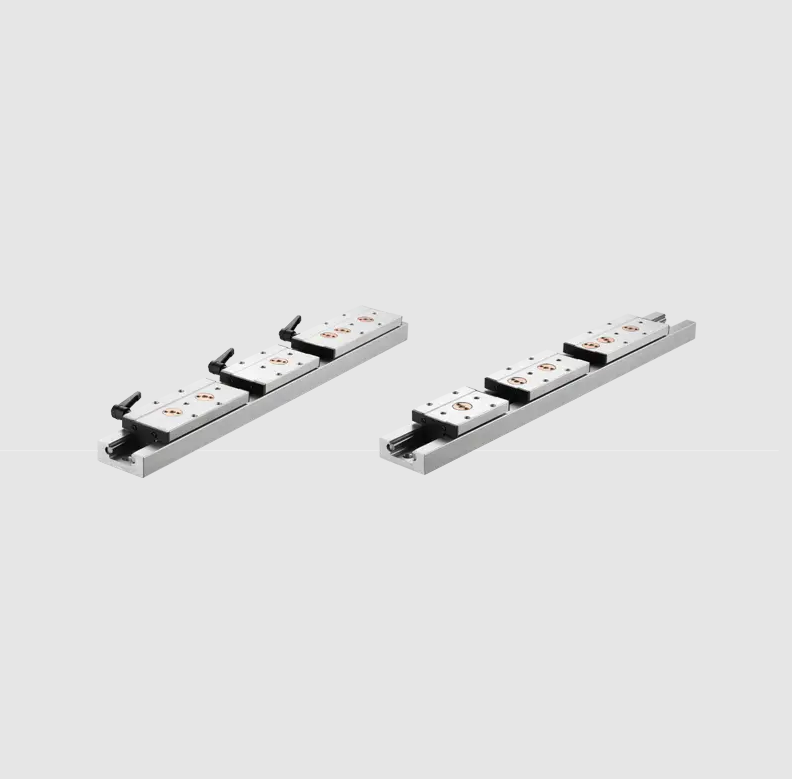
READ MORERoller and cylindrical linear guides offer an economical, efficient, robust, and durable linear motion solution. Their primary classification is based on core working principles, structural forms, and installation characteristics to meet the diverse needs of different scenarios, from heavy-duty handling to precision positioning, in terms of load capacity, accuracy, environmental adaptability, and cost.
Core classifications are as follows:
Roller Guides
Based on the core principle of V-shaped rollers rolling on a track. Further subdivided by installation method:
External/Open Type: Such as the LGD series. The track is independently installed, and the roller assembly engages externally, facilitating installation, commissioning, and maintenance. Suitable for long-stroke, open-structure conveyor lines or large frames.
Internal/Enclosed Type: Such as the SGR series. The track is integrated into the profile or support structure, resulting in a compact and clean structure. It provides better dust and splash protection and is commonly used inside automated equipment or in scenarios requiring high cleanliness.
Cylindrical Linear Guides
Using a round steel shaft as the track, in conjunction with linear bearings (sleeves). Further subdivided:
Standard Cylindrical Guides: Such as the SBR series. Typically composed of hardened and ground optical shafts and standard linear bearings, this is the most economical and widely used linear guide solution, suitable for light to medium loads and general applications where extreme precision requirements are not necessary.
Enhanced/Precision Cylindrical Rails: Such as the TBR series. These may employ higher precision optical shafts, preloaded bearings, or special support structures to improve rigidity, precision, and torque resistance, suitable for more demanding industrial equipment.
Drawer Rails
Specialized rails designed for drawers, cabinets, and other telescopic mechanisms, such as the OLG series. They typically feature full extension, self-closing, and damping functions, emphasizing smooth load-bearing, easy installation, and user experience.
This product line covers everything from economical and general-purpose cylindrical rails to robust and durable roller rails to functional, dedicated drawer rails. When selecting a rail, key considerations include load capacity, speed, precision, installation space, and environmental protection requirements. Roller rails excel in heavy loads and harsh environments, while cylindrical rails are known for their high cost-effectiveness and flexibility.

Your motion system is losing positioning accuracy mid-run. The actuator is running hotter than it should. Maintenance intervals are creeping shorter, and the en...
READ MOREA Roller / Cylindrical Linear Guide Set is a precision linear motion component designed to support moving parts and guide them along a straight path with stable accuracy, controlled friction, and high rigidity. Instead of relying on sliding contact, roller-type linear guides use cylindrical rolling elements to reduce resistance and improve motion consistency under load.
This type of guide set is commonly used in equipment that requires high load capacity, strong rigidity, smooth movement, and repeatable positioning performance. It is suitable for CNC machinery, automation systems, industrial robots, semiconductor equipment, inspection machines, packaging equipment, and other mechanical systems where the quality of linear motion directly affects machine performance.
A typical roller or cylindrical linear guide set includes a guide rail, guide block, cylindrical rollers, cage or circulation structure, end caps, seals, lubrication channels, and mounting accessories. Different rail lengths, block structures, preload levels, accuracy grades, and surface treatments can be selected according to machine design and operating conditions.
A roller or cylindrical linear guide set is used to provide accurate and stable linear movement between fixed and moving machine components. The guide rail is installed on the machine base or frame, while the guide block travels along the rail. Inside the block, cylindrical rollers contact the raceway surface and transfer load through rolling motion.
This structure allows the guide set to carry loads from multiple directions, including:
Because cylindrical rollers have a larger contact area than ball elements, roller linear guides usually provide higher rigidity and stronger load-bearing performance. This makes them suitable for heavy-duty applications and precision equipment where vibration, deflection, and positioning errors need to be reduced.
Common product names include:
The value of this component is not limited to guiding movement. A properly selected guide set can help improve machine stability, extend service life, and support consistent repeat positioning over long operating cycles.
Roller / Cylindrical Linear Guide Sets are used across a wide range of industrial equipment. They are often selected for applications where motion must remain stable under heavy load, frequent operation, or demanding working conditions.
Typical application areas include:
In new machine development, roller linear guide sets are often integrated into standard motion systems from the design stage. In equipment maintenance and upgrading, they are used to restore motion accuracy, improve load support, or replace worn guide components.
In CNC and automation applications, the linear guide usually works together with ball screws, servo motors, couplings, bearings, and machine frames. A suitable roller guide system helps reduce motion resistance, improve positioning stability, and support long-term equipment operation.
The performance of a cylindrical roller guide depends on material quality, heat treatment, machining accuracy, assembly precision, and lubrication design. Each factor influences load capacity, running smoothness, wear resistance, and service life.
Common materials include:
The guide rail and block are usually heat-treated to improve hardness, wear resistance, and dimensional stability. After hardening, the raceway surfaces are precision ground to achieve the required straightness, surface roughness, and geometric accuracy.
Common structural options include:
The roller circulation structure or cage design affects movement smoothness, noise level, lubrication efficiency, and operating life. For high-speed movement, frequent reciprocating motion, or dusty environments, sealing performance and lubrication access should be considered during product selection.
Preload is also an important technical factor. A higher preload can improve rigidity and reduce clearance, but it may increase movement resistance. A lower preload can provide smoother movement, but with less stiffness. The preload level should be matched with machine load, travel speed, accuracy requirement, and installation condition.
WANGONG focuses on precision transmission components and provides Roller / Cylindrical Linear Guide Sets for CNC machinery, automation equipment, industrial robots, inspection systems, packaging machinery, and other linear motion applications.
With manufacturing experience since 2008, WANGONG supports stable production, practical product selection, and custom linear guide solutions for different equipment requirements.
Product experience covers roller guides, linear guides, ball screw assemblies, linear shafts, and linear sliding units.
Key processes include material inspection, heat treatment, precision grinding, assembly, preload adjustment, running test, and final inspection.
Inspection focuses on rail straightness, raceway hardness, surface roughness, dimensional accuracy, movement smoothness, and preload consistency.
Options include custom rail length, block type, preload level, accuracy grade, surface treatment, anti-rust packaging, product marking, and private label packaging.
WANGONG can help match guide sets according to load capacity, installation space, motion speed, working environment, and equipment structure.
Standard models and customized specifications are available for equipment manufacturing, maintenance replacement, and industrial component projects.
WANGONG aims to provide linear guide sets with stable performance, consistent quality, and practical support for long-term precision motion applications.